
Your closet looked better yesterday. Somehow it always does. You pull one shirt, the stack collapses, and suddenly everything feels broken again. I spent three years rotating between four different systems before anything actually stuck.
The problem usually isn’t the closet. It’s the order of decisions you make inside it. Get that sequence wrong and no bin, basket, or fancy velvet hanger saves you. This guide walks through 21 specific methods, in the right order, so you stop solving the same problem twice.
Most people jump straight to buying storage products. That’s backwards. The system has to come before the stuff.
Strip Everything Out Before You Sort Anything
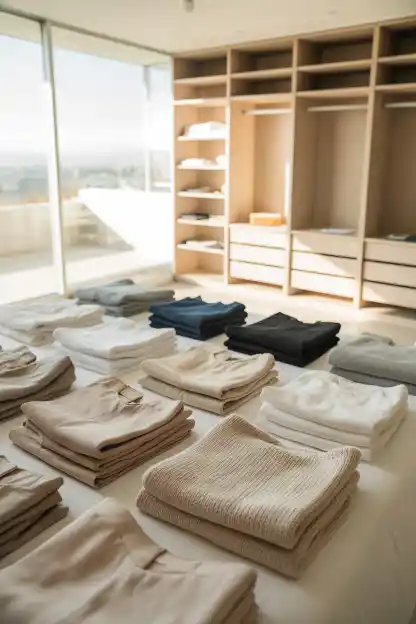
Empty closet first. Every single time. I used to reorganize around items still hanging, telling myself I’d deal with the corners later. Later never came. The corners became permanent problem zones.
Once everything is on the bed, you see the actual volume. It’s usually shocking. Most people own two to three times more clothing than their closet space can realistically hold.
This is also the moment to start decluttering your closet first before touching a single bin or hanger. Organizing clutter just hides it better. That’s not a system, that’s theater.
Sort Into Hard Categories, Not Soft Ones

“Maybe” piles are closet poison. You put twelve shirts in the maybe pile and nine of them sneak back into rotation without earning it. Be brutal with categories: keep, donate, trash, seasonal storage.
Hard categories force real decisions. Soft ones delay them. The delay is exactly what caused the current chaos in the first place.
Once your keep pile is final, sub-sort by type before touching the closet. Tops together. Bottoms together. Dresses, jackets, loungewear. Seeing the groups laid out flat tells you how much hanging space each category actually needs.
Map Your Closet Zones Before Hanging Anything
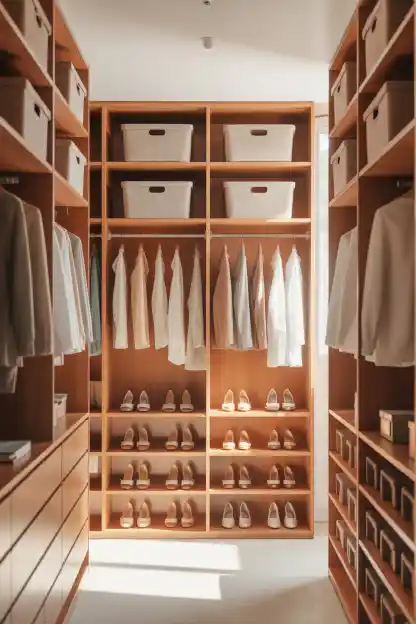
Three zones matter most: prime real estate, mid-range, and dead zones. Prime real estate is eye level and arm reach. Mid-range is slightly above or below. Dead zones are the far corners and floor edges.
Assign your most-used clothes to prime real estate without exception. Your daily work shirts should never live in a corner. That sounds obvious but almost nobody does it by default.
Checking out small closet organization ideas before you map zones is worth it, especially if you’re working with under four feet of hanging rod. Zone mapping changes completely in tight spaces.
Use Uniform Hangers for Every Single Item

Mismatched hangers waste more space than almost any other single factor. A chunky plastic hanger takes almost double the rod space of a slim velvet one. Multiply that across forty shirts and you lose roughly eight inches of rod.
Velvet slim hangers are the correct answer for most closets. They grip fabric, prevent shoulder bumps, and pack tightly without tangling. I switched to a full set of black velvet hangers three years ago and never looked back.
You can find coordinating styles that work well with hanger hacks for closets to double your hanging capacity without adding a single rod. The hanger choice is underrated. Most people treat it as cosmetic. It isn’t.
Hang by Category, Then by Color Within Each Category

Hanging by color alone looks pretty but functions terribly. You’re searching by clothing type first, not by color. Color within category is the correct layering order.
All white shirts together, then light blue, then dark blue, then black. Inside the “tops” section only. Same logic applies to pants, jackets, dresses. Each category gets its own color gradient.
This system pays off after laundry day most of all. You know exactly where each item returns. Putting things away gets faster, which means things actually get put away instead of landing on the chair.
Fold What Should Be Folded and Stop Fighting It
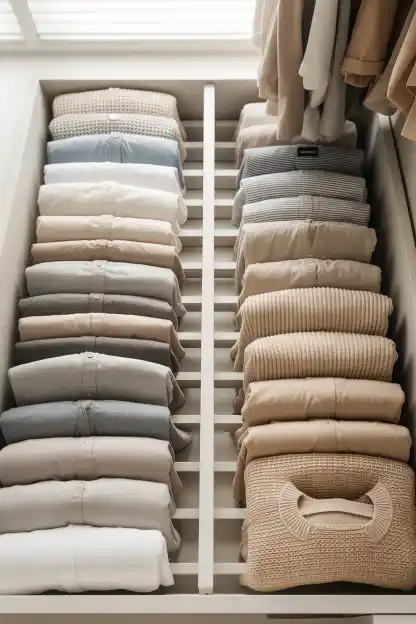
Some items genuinely hang better folded. Knitwear stretches on hangers. Heavy denim bags and distorts. Casual t-shirts in heavy rotation often fold and stack faster than they hang.
The vertical folding method, where items stand upright like files in a drawer, works better than stacking for most shelf situations. You can see every item at once. Pulling one out doesn’t destroy the row.
If you’re working through organizing shirts in your closet, it’s worth deciding which shirts get hung and which get folded before you start. Mixing both methods in one pile produces a reliable mess within two weeks.
Assign Every Shelf a Specific Job
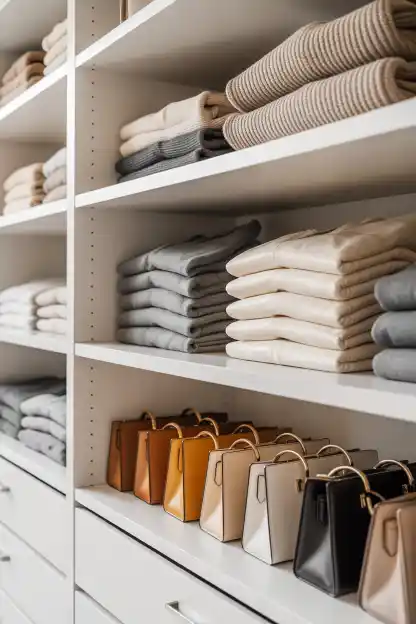
Shelves without assignments become dumping grounds. I know this because I had a beautiful white shelf in my old apartment that held nail polish, a phone charger, a random belt, and three paperback books. Not one item of clothing.
Give each shelf one category and only one. Sweaters on the top shelf. Folded pants on the middle. Bags on the lower shelf. Write it on a sticky note inside the door if you need the reminder at first.
The iDesign shelf dividers are genuinely useful here. They keep folded stacks from toppling sideways, which is the main reason folded shelves fall apart by day four. One divider per stack is usually enough.
Dedicate a Full Section to Seasonal Rotation
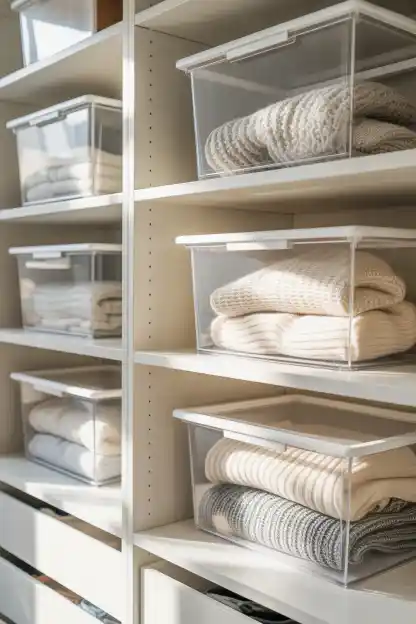
Wearing your winter coat in July just to store it is not a system. Seasonal rotation means your closet only holds what fits the current three to four months. Everything else lives somewhere else.
Off-season items belong in labeled bins on high shelves, under beds, or in a secondary closet. Clear bins work better than opaque ones here because you can see what’s inside without opening them. The mDesign stackable bins with lids handle this well.
Here’s where most people get stuck: they rotate seasonally but forget to edit while doing it. Every rotation is a second chance to cull items that didn’t get worn. Use it.
File Fold Jeans to Stop the Chaos
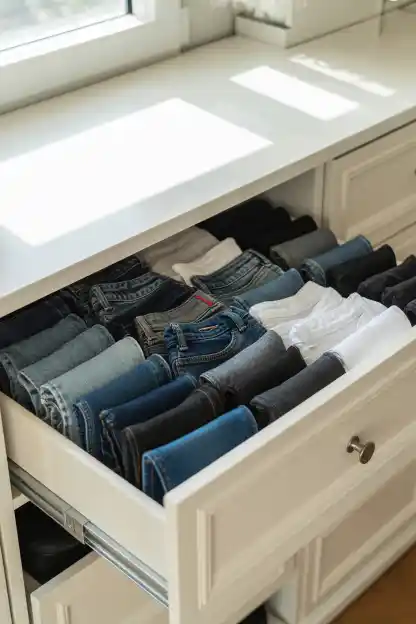
Folded sweaters fall sideways. Always. But folded jeans have a different problem. People try to stack them flat and then pull from the middle, which topples the whole pile immediately.
File folding jeans vertically so they stand in a drawer or bin solves this completely. You see every pair at a glance. You pull one without disturbing the others. The system holds for weeks without touching it.
For anyone still figuring out storing jeans without creases, the fold method matters as much as the storage location. A good fold in a bad spot still beats a bad fold anywhere.
Use the Floor Zone Intentionally
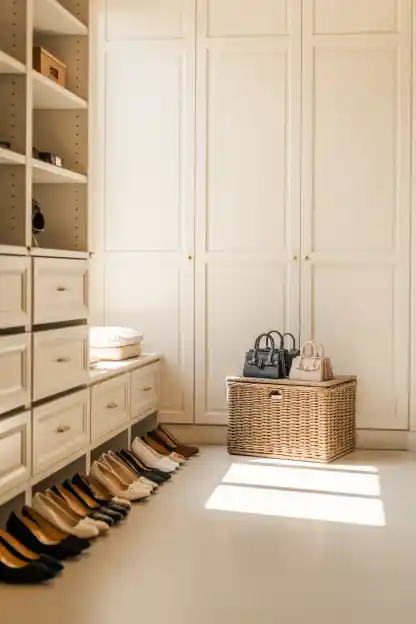
Most closet floors are where intentions go to die. Shoes kicked in randomly, a gym bag shoved sideways, a pile of things that “don’t have a place yet.” That last category is the dangerous one.
The floor zone should hold only items that genuinely belong at floor level. Shoes, yes. A low basket for bags, yes. Nothing without a designated category. OXO containers are better for shelf use, but a simple low-profile bin handles floor organization well.
A clear rule for the floor zone: if it can be hung or shelved, it doesn’t live on the floor. Full stop. That one rule prevents 80% of the floor creep I see in every disorganized closet I’ve worked with.
Build a Dedicated Accessories Wall or Section
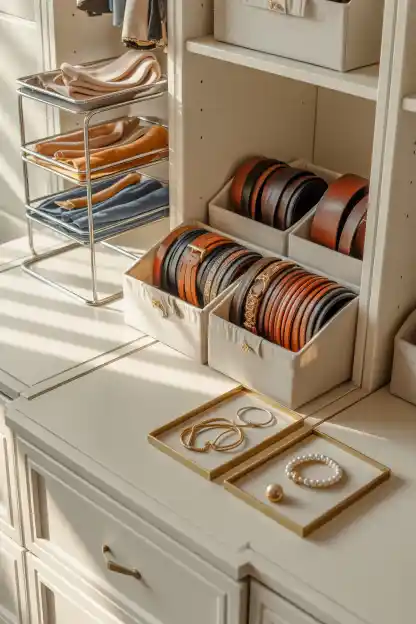
What if the obvious fix is the wrong one? Most people throw a hook on the door and call the accessories problem solved. It isn’t. One hook holds three things before it becomes a fabric pile.
Accessories need their own mapped section, not a catch-all spot. Belts rolled and stored vertically in a small bin. Scarves folded on a shelf or hung on a multi-bar hanger. Jewelry on a mounted tray or inside a drawer organizer.
Command strips handle the mounting without drilling for lightweight items like small hooks or narrow trays. In rentals especially, this is the difference between a functional system and a landlord problem.
Keep a Donation Spot Inside the Closet

I watched a neighbor install a small canvas bin inside her rental apartment closet specifically for ongoing donations. Nothing fancy. Just a labeled bin on the lower shelf. She said it changed her relationship with decluttering completely.
The reason it works: the decision and the action happen at the same moment. You try on a shirt, it doesn’t fit right, and it goes directly into the donation bin instead of back on the hanger. No delay, no second-guessing.
When the bin fills, it goes to the car. Then to the donation center. The whole loop takes less friction than the alternative. Build the bin into the closet architecture from day one.
Hang Heavy Items Low, Light Items High
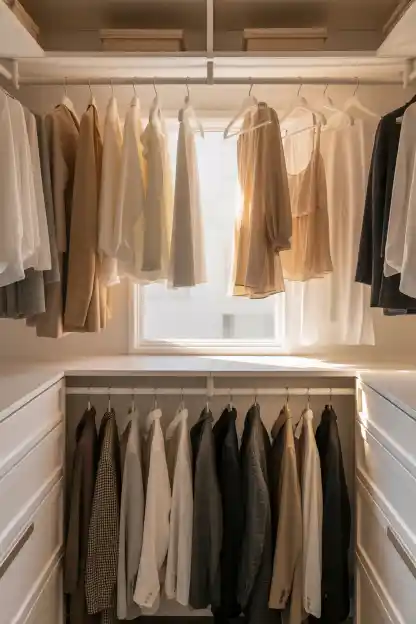
This is structural common sense but it gets ignored constantly. Heavy blazers, thick winter coats, and weighted denim jackets hanging at eye level put uneven stress on the rod over time. Rods bend. Then they fail.
Heavy items hang lower or get stored on reinforced shelves. Lighter items, silk blouses, thin cardigans, summer dresses, go on the upper rod sections. The weight distributes better and the closet feels physically balanced.
This also makes visual sense. Lighter fabrics at eye level and above keep the space feeling open. Dense heavy items lower down create an anchored, grounded look that doesn’t feel chaotic.
Label Everything That Isn’t Visually Obvious

Some closet storage is self-explanatory. A row of hanging shirts needs no label. A clear bin of sandals needs no label. But an opaque box on a high shelf needs a label immediately or it becomes a mystery box within one month.
Labels don’t have to be fancy. A piece of masking tape and a marker is completely functional. The point is reducing the decision cost of finding and returning items. That cost adds up over hundreds of small interactions.
If you want something more polished, printed label holders that clip onto bins look clean and stay readable. The key is applying them before you close the closet for the first time after reorganizing. Later almost never happens.
Create a “Needs Attention” Hook
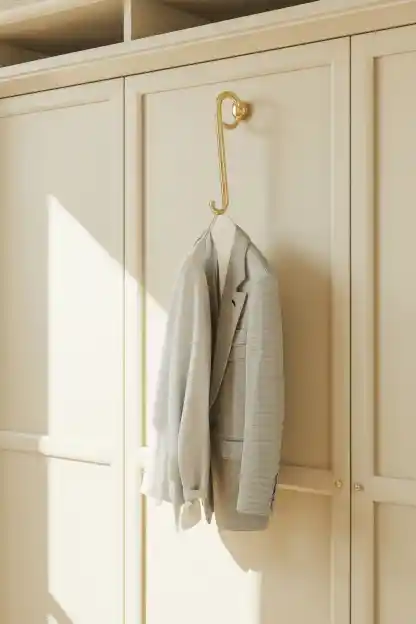
One hook, one rule. Anything that needs minor repair, tailoring, or a missing button gets hung on the needs attention hook instead of returning to regular rotation. Not on the floor. Not stuffed back in a drawer.
This is a confession: I spent years putting things “back for now” that needed buttons sewn, seams fixed, or hems let down. They’d circle back into the laundry cycle unworn. The hook made the problem visible and urgent.
When the hook holds more than three items, that’s a signal to schedule the repairs. Visible problems get solved. Hidden ones stay broken.
Use Vertical Space Above the Rod
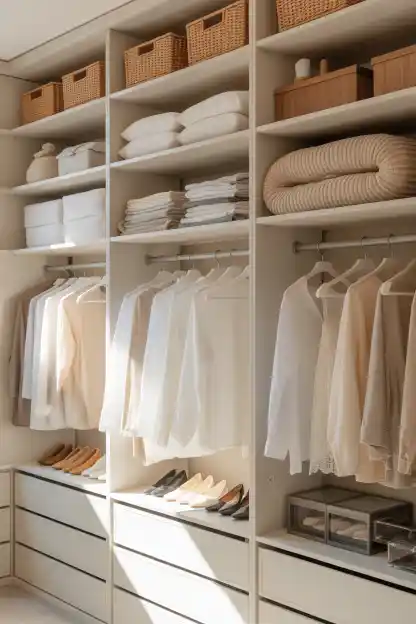
Most standard closets waste a full foot to eighteen inches of space above the hanging rod. That dead space above the clothes holds a remarkable amount when used with the right containers.
Flat storage bins slid onto high shelves hold spare bedding, off-season accessories, or event clothing worn rarely. The IKEA KALLAX system isn’t designed for closets, but its square bins work on wide built-in shelves above rods with surprising efficiency.
Revisiting closet organization hacks is useful when planning vertical use because the tricks for above-rod storage often get skipped in standard organization guides. Height is free space. Use it.
Standardize Your Folding Method
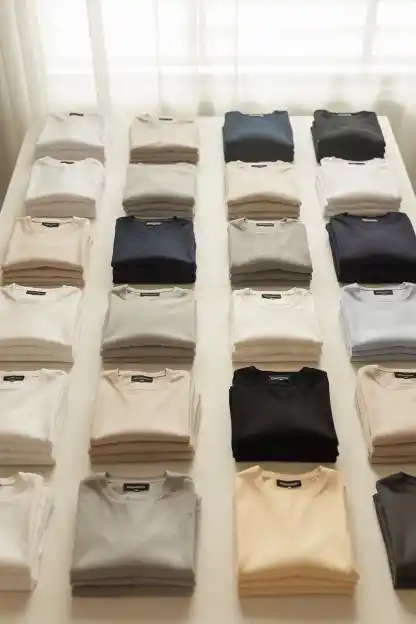
Different folding methods for the same type of item create inconsistent stacks that fall apart at different speeds. Pick one method per category and use it every single time.
I use the file fold for t-shirts, a flat half-fold for sweatshirts, and a third-fold for dress pants. Every item in those categories gets the same treatment. The stack stays stable because every piece is the same height and width.
This sounds obsessive until you’ve lived with it for a month. Then you realize the ten seconds of consistent folding prevents fifteen minutes of reshuffling every weekend.
Protect Your System on Laundry Day
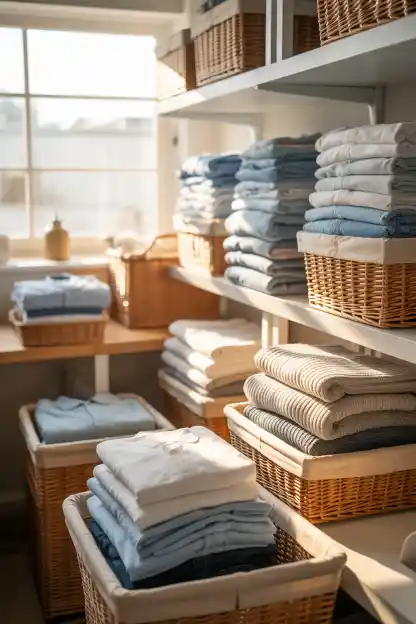
Laundry day is when most closet systems collapse. You’re tired, there’s a full basket, and shortcuts feel very appealing. One round of throwing things “roughly” back in place undoes a week of work.
Build a return-to-closet ritual instead. Sort the clean laundry before carrying it to the closet. Walk in with tops, walk in with bottoms, walk in with jackets. Category by category, not one chaotic trip.
The five extra minutes on laundry day is the actual maintenance cost of an organized closet. That’s the real price. It’s surprisingly affordable.
Add a Mirror to Check the System Visually

Three hangers turned backwards in a closet is a used trick for tracking unworn items. But a mirror inside or on the closet door does something different. It shows the whole system at a glance.
A mirror reveals visual chaos before it becomes structural chaos. If the reflection looks cluttered, something has drifted from its category. Catching it visually early is faster than a full re-sort every few months.
This also connects to checking out master closet organization ideas if you have larger shared closet space. A mirror in a shared closet reduces the “whose pile is that” problem significantly.
Do a Ten-Minute Reset Weekly

Ten minutes. Every Sunday or whatever your consistent day is. Rehang anything on the chair. Return items to their zones. Refold anything that collapsed.
This weekly reset is the maintenance that makes everything else work. Without it, every closet system drifts back toward chaos within three weeks. That’s not a flaw in the system. It’s just how clothing storage behaves under daily use.
The ten minutes feels easy when the closet is mostly in order. It feels impossible when you’ve skipped it for three weeks. Don’t skip it for three weeks.
Revisit the Whole System Every Six Months

What worked in January doesn’t always work in July. Life changes, wardrobe changes, habits change. A six-month review isn’t a failure of the original system. It’s maintenance on a living thing.
Schedule it. Put it on a calendar the same way you’d schedule a car service. Pull everything out again, or at least audit each zone for drift. Adjust what isn’t working instead of abandoning the whole structure.
The best closet systems are slightly boring. They require almost no thought to maintain. Getting to boring takes iteration. Six months gives you enough use data to know what needs adjusting.
Final Thoughts on Organizing Clothes in Your Closet
Organized closets don’t stay organized because the owner has willpower. They stay organized because the system removes friction at the decision points that matter most. The return trip, the laundry day, the hurried morning.
Every method in this list addresses a specific failure point. Not every method applies to every closet. Pick the ones that match your real habits, not your idealized ones.
Start with the strip and sort. Build the zones. Then add structure. In that order.
FAQ About Organizing Clothes in Your Closet
What is the most effective first step to organizing a clothes closet?
Remove everything before making any decisions. Sorting inside a full closet means working around the existing mess. Empty shelves show you the real space you’re working with.
How often should a closet be reorganized from scratch?
A full reset once or twice a year is enough if you’re doing weekly ten-minute resets in between. Without the weekly maintenance, a full reset every few months becomes necessary.
What products actually make a lasting difference in closet organization?
Slim velvet hangers, shelf dividers, and clearly labeled bins make the most consistent impact. Expensive custom systems don’t perform better than these basics if the underlying categories and zones aren’t defined first.
Sarah Mitchell’s Take
I’ve reorganized closets professionally and personally, and the honest truth is I still let my returns pile up on the chair for two days sometimes. The system matters more than perfection. A slightly imperfect consistent system will always outlast a flawless one that falls apart on a tired Tuesday.
—